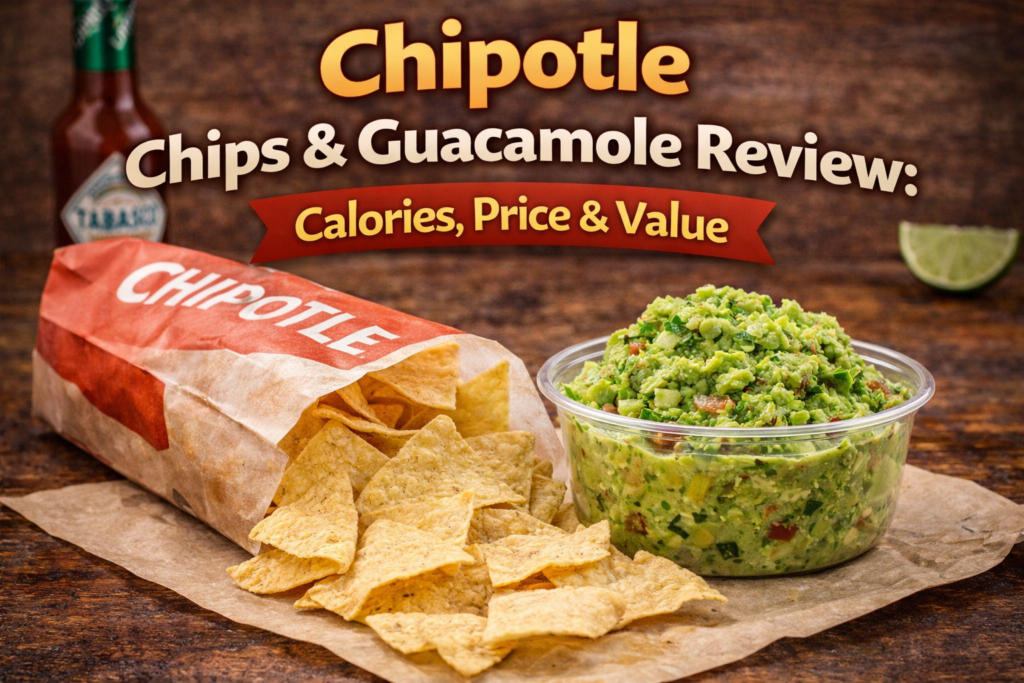
Chipotle Chips & Guacamole Review: Calories, Price & Value
There is a specific kind of shame that comes with paying extra for guacamole at Chipotle. The cashier slides your bowl across the counter, eyes you with the dead stare of someone who has delivered this sentence ten thousand times, and says: “Just so you know, guac is extra.” And every single time, without fail, you say yes anyway.
I have been saying yes for years. And honestly? I regret nothing.
But after years of casually scooping guac onto chips without a second thought, I finally sat down to do what I probably should have done a long time ago — give Chipotle’s Chips & Guacamole the proper editorial treatment it deserves. A full breakdown of what you’re eating, what you’re paying, what the nutrition actually looks like, and whether the whole thing is genuinely worth it in 2025 and beyond.
Spoiler: it is. But it’s complicated. Let me explain.
First, Let’s Talk About What You’re Actually Getting
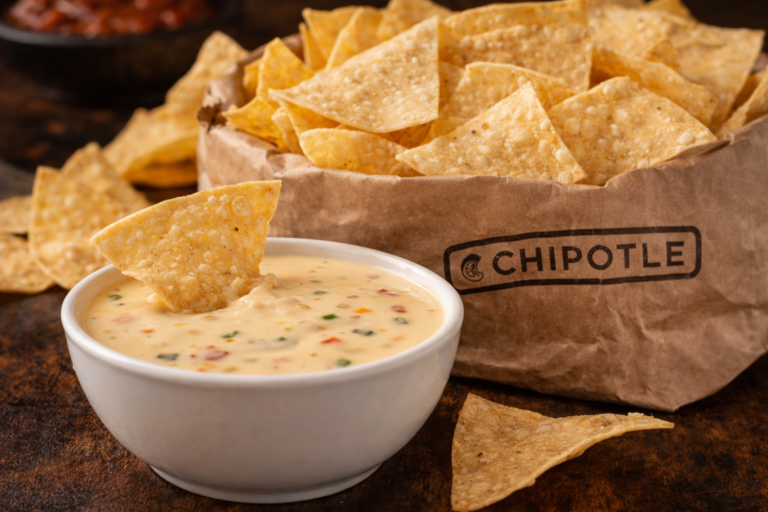
Chipotle’s Chips & Guacamole is available in two configurations: the standard size (chips + a 4 oz portion of guac) and the large version (chips + 8 oz of guac). The chips themselves are corn tortilla chips fried in sunflower oil, then tossed with fresh lime juice and sea salt while still hot. That’s the entire recipe. No artificial flavors, no powder coatings, no mystery seasonings — just corn, oil, citrus, and salt.
The guacamole recipe is equally stripped back. Chipotle’s executive chef has publicly shared the full formula: Hass avocados (sourced primarily from Mexico), fresh-squeezed lime juice, chopped cilantro, diced red onion, diced jalapeños, and kosher salt. That’s six ingredients. No sour cream, no mayonnaise, no garlic powder, no fillers. Every batch is made by hand in-store throughout the day.
This matters more than it sounds. A lot of fast-food guacamole is quietly padded with cheaper ingredients — some chains have even been caught using calabacita, a Mexican squash, as a base extender. Chipotle’s commitment to real avocados, at scale, is part of why the product costs what it does and why it consistently tastes better than you’d expect from a chain doing millions of orders a day.
The Taste: What You’re Really Paying For
I’ve eaten Chipotle’s guacamole in about eight different states across the country at this point, ordered it as a standalone snack, layered it into bowls, and eaten it at 11am when they’ve just made the first batch of the day and at 7:30pm when the bin is starting to show its age. Here is what I can tell you from all of that accumulated experience:
When it’s good — and it usually is — Chipotle’s guac hits a texture balance that most homemade versions struggle to replicate. There’s a specific ratio of smooth to chunky that they maintain really consistently. You get pockets of avocado that haven’t been fully mashed, surrounded by a creamier base that holds everything together. The lime is assertive without being sour. The jalapeño is present without being punishing. The cilantro is noticeable without overpowering.
The chips are the unsung hero of this combo. They come out warm at good locations, and that warmth is actually critical. A warm chip has a different structural integrity than a room-temperature or cold chip — it bends slightly before it breaks, which means you can load more guacamole onto each one without the whole thing snapping. Anyone who has eaten a cold stale chip that shatters under the weight of a full scoop knows exactly what I’m talking about. When Chipotle’s chips are fresh, they’re genuinely excellent. Light, a little oily in the best possible way, with that citrus salt hit that makes them hard to stop eating even before you’ve touched the guac.
The combination is textbook contrast eating. Cool, fatty, herby guacamole against hot, salty, crunchy chips. It’s not a revolutionary concept, but it works so well here that it’s easy to forget you’re at a fast casual chain and not a sit-down Mexican restaurant.
That said, consistency varies by location and time of day. I’ve had batches where the guac was slightly under-seasoned, times when it was a bit too watery from overly ripe avocados, and a handful of occasions where the chips had clearly been sitting in the bag for too long and lost their crunch entirely. These aren’t common experiences, but they happen. The product is only as good as the team making it that day.
The Price: Where Things Get Real
Here is where we need to have an honest conversation.
As of early 2026, the standard Chips & Guacamole combo runs approximately $4.95 at most U.S. locations. The large version — which gives you a 6 oz bag of chips and an 8 oz portion of guacamole — comes in around $8.70, though prices fluctuate depending on where you are. Urban markets like New York City or San Francisco can push that figure closer to $9.50. The standalone guacamole side (which you’d add to a bowl or burrito) is typically $2.95 for a 4 oz portion.
These are not cheap numbers. Especially when you consider that a whole ripe avocado at the grocery store costs $0.89 on a good week and a bag of tortilla chips is maybe $3.50. The markup is significant, and it would be dishonest to pretend otherwise.
But price isn’t evaluated in a vacuum. When I’m at Chipotle and I order chips and guac as a side or a starter, I’m paying for: someone else’s prep work, the freshness guarantee of ingredients made that day, a portion size that’s actually appropriate, and the experience of eating something that tastes noticeably better than what I’d throw together at home in five minutes. That last point is the one people push back on, but I genuinely stand by it. The care Chipotle puts into ripeness selection and daily preparation shows up in the final product in a way that is hard to fake.
Is it worth $4.95 as a standalone snack? Mostly yes, if the chips are fresh. Is it worth $8.70 for the large? That depends heavily on whether you’re splitting it or eating it solo, and whether you’re also buying an entrée. If you’re dropping $12–$14 on a bowl or burrito and then adding $8.70 on top for the large chips and guac, you’re approaching $22–$23 for a fast casual lunch — which is a number that requires some honest self-reflection.
My personal move: the standard size ($4.95) as a side to a bowl is the sweet spot. You get enough chips and guac to complement your meal without it feeling like an extravagance. And honestly, if you’re building something like a Chipotle salad bowl — which tends to be on the lighter, more vegetable-forward end — the chips and guac bring enough substance and healthy fat to make the whole thing genuinely filling.
The Nutrition: Let’s Get Into the Numbers
Chipotle’s Chips & Guacamole is not a low-calorie item, and it’s important to go in with realistic expectations rather than convince yourself that avocado makes everything healthy.
Here’s a clear breakdown by size:
| Size | Total Calories | Chips Calories | Guac Calories | Approx Price |
|---|---|---|---|---|
| Standard (4 oz guac) | ~770 cal | ~540 cal | ~230 cal | $4.95 |
| Large (8 oz guac) | ~1,270 cal | ~810 cal | ~460 cal | $8.70 |
| Guac side only (4 oz) | 230 cal | — | 230 cal | $2.95 |
The macronutrient split for the combo runs roughly 41% carbohydrates, 54% fat, and 5% protein. The fat content is high, but it’s worth understanding what kind of fat you’re dealing with. The guacamole’s fat profile is almost entirely from avocados — meaning you’re looking at monounsaturated and polyunsaturated fats, not saturated animal fats. A standard 4 oz serving delivers approximately 21 grams of total fat, of which around 13 grams are monounsaturated (the kind associated with heart health) and 2.5 grams are polyunsaturated.
The fiber content is also worth noting: a 4 oz serving of guacamole alone provides about 9.4 grams of dietary fiber, which is a genuinely substantial contribution toward your daily target of 25–38 grams. The chips are corn-based and gluten-free, and while they’re fried, the sunflower oil used is relatively neutral in terms of its fat profile.
The number that gives me pause is sodium. A standard guacamole serving contains around 648mg of sodium, and the chips add more on top of that. If you’re watching your salt intake — or if you’re pairing this with something like Chipotle’s barbacoa tacos, which are themselves not light on sodium — the cumulative numbers can climb quickly. It’s not a reason to avoid the dish, but it’s a reason to be aware of it.
The calorie count on the large size (1,270 calories) is significant. If you’re eating the large chips and guac as a snack before or alongside a full entrée, you’re potentially consuming most of your daily calorie budget in a single Chipotle visit. This isn’t a judgment — sometimes that’s the move — but it’s information worth having.
Is It Healthy?
The honest answer is: it depends entirely on context and portion. The guacamole itself is genuinely nutritious. Avocados are one of the most nutrient-dense foods you can eat — packed with potassium (about 710mg per serving, which is more than a medium banana), vitamins E and K, folate, and the kind of healthy fats that your body actually uses well. The ingredients list is clean and short. Nothing about the guac is junk food.
The chips are a different story. They’re delicious, but they’re fried corn chips. They’re not vegetables. They contribute a meaningful calorie load relative to the nutrition they provide. If you’re using guac as a topping on your bowl and skipping the chips entirely, you’re getting a genuinely health-forward addition to your meal. If you’re eating the full chips and guac combo as a 770–1,270 calorie side order, you need to plan your overall meal accordingly.
My approach on health-conscious visits: I order the guacamole side instead of the full chips-and-guac combo, add it directly to my bowl, and skip the chip bag entirely. You get all the nutritional benefit of the avocado without the caloric weight of the chips. On days when I’m not counting anything and just want the full experience? I get the standard chips and guac and enjoy every bit of it without guilt.
Consistency Across Locations: The Real Variable
If I had to identify the single biggest weakness in Chipotle’s Chips & Guacamole, it’s the variability between locations and time-of-day freshness. Because the guacamole is made in-store daily and the chips are fried on-site, the quality depends heavily on how busy the location is and how recently each batch was made.
A Chipotle that’s running high volume — say, a downtown lunch rush location that’s blowing through a new batch of guac every 20 minutes — will serve you something that’s noticeably better than the quiet suburban location that made its guac three hours ago and has let it sit at room temperature ever since. The same is true for chips. A bag that’s been sitting in the warmer for 45 minutes is a worse product than chips that just came out of the fryer.
Practically speaking, here’s how I’ve learned to game this: I try to visit Chipotle during peak hours (11:30am–1pm or 6pm–7:30pm) specifically because high volume means faster turnover of fresh product. I also ask for chips from a new bag if they look like they’ve been sitting. Most staff will accommodate without complaint. And if I’m ordering online or through the app for pickup, I’ve learned to add chips and guac as a note to prepare fresh — again, most locations do this without issue.
The Sharing Question: How Many People Does It Actually Feed?
The standard Chips & Guacamole is appropriately sized for one person as a generous snack or a modest side. If you’re two people sharing it as a starter before your individual entrées, it’s on the smaller side — you’ll get a few chips each with guac before the bowl is scraped clean. For shared appetizer use, I’d recommend going straight to the large.
The large size is well-suited for two to three people sharing as a table starter. As a solo order, it’s a commitment — not in terms of price, but in terms of the 1,270 calories you’re taking on before you’ve touched your main item. I’ve done it. I have no regrets. But I was done with food for the rest of the day.
One thing I appreciate about the portion structure: Chipotle doesn’t charge a disproportionate upcharge for going large. The roughly $3.75 difference between standard and large gives you double the guacamole and more chips, which is fair math. There’s no “premium tax” on the larger size beyond what the extra ingredients actually cost.
The Guac Add-On vs. Standalone Chips and Guac: Which Is the Better Value?
This is a question worth answering directly, because the math is interesting.
A standalone guacamole side (4 oz, $2.95) added to a bowl or burrito costs less than the chips-and-guac combo ($4.95), but it also comes without chips. The difference of $2.00 is effectively the price of the chip bag. If you want chips, the combo is the obvious choice. If you’re adding guac to an entrée and don’t need chips, the standalone side is the more efficient option.
The mistake I see people make: ordering both a full entrée and the large chips-and-guac combo, then realizing they’ve effectively ordered two full meals. Unless you’re splitting the entrée, this is almost always too much food. The smarter move for most single diners is either the entrée with a guac side add-on, or the standard chips-and-guac combo as the main event with no additional entrée. Both work well as complete meals in their own right.
Where Chips & Guac Fits in the Broader Chipotle Ecosystem
Chipotle’s menu has a clear logic to it, and chips and guac occupy a specific and important role in that structure. They serve as the bridge item — the thing that turns a bowl into a complete meal experience, or the thing that turns a quick solo lunch into something that feels more social and relaxed.
I find that chips and guac pair best with the lighter, more vegetable-forward orders on the menu. Something like a salad bowl, for instance, can feel a little sparse and protein-light on its own — the chips and guac bring both substance and a flavor dimension (the fat richness of the avocado) that the bowl itself sometimes lacks. Conversely, if you’re ordering something as dense and protein-heavy as barbacoa tacos — which are already rich and filling on their own — adding chips and guac as a starter tends to leave you genuinely overfull before you’ve finished your main course. There’s a reason the chips-and-guac combo is listed as a side item, not a starter: at Chipotle’s portion sizes, it’s substantial enough to function as either, but it works better as the former.
The guac-as-topping-on-a-bowl use case is probably my most common order pattern. When I’m putting together something like a salad bowl with careful nutrition in mind, adding guac instead of sour cream gives me healthy fat and creaminess without the dairy and the heavier caloric load. It’s one of the smarter swaps you can make at Chipotle.
National Guacamole Day: The One Time It’s Free
Worth mentioning for regular Chipotle customers: every September 16th, Chipotle runs their National Guacamole Day promotion, which offers free guacamole to customers who place an order through the Chipotle app or online. It’s one of the brand’s signature annual promotional events, and if you’re a consistent Chipotle customer, it’s genuinely worth knowing about and planning around.
The promotion has historically required an entrée purchase to unlock the free guac, so it’s not a standalone free item — but if you were already going to order, getting the guac at no extra charge is a meaningful saving, particularly if you’re getting the larger portion.
The Competition: How Does It Stack Up?
Benchmarking Chipotle’s chips and guac against competitors reveals why the product maintains its reputation despite the price.
Taco Bell’s guacamole, when they offer it, is noticeably different in texture — smoother, more processed, without the chunky avocado character of Chipotle’s version. Qdoba offers a similar hand-made guacamole that genuinely competes on quality, but the chip quality at Qdoba is typically inferior — bagged chips rather than house-fried ones. Moe’s Southwest Grill comes closer in terms of the in-store freshness model, but the guac at Moe’s tends to be less consistent.
For sit-down Mexican restaurants, the comparison becomes less fair — a proper tableside guacamole made with high-end ingredients will always beat anything a fast casual chain produces. But in the fast casual space, Chipotle’s chips and guac occupies a genuine leadership position, both on quality and consistency.
My Honest Verdict
After all these years and all these orders, here is where I land:
Chipotle’s Chips & Guacamole is one of the most defensible extra spends in fast casual dining. The ingredients are real. The preparation is genuinely daily and fresh. The taste-to-effort ratio (on your part) is exceptional — you get something that would take you 20 minutes to assemble at home, made well, for under five dollars in its standard configuration. Yes, the large size can get expensive. Yes, the calorie count at large is meaningful. Yes, consistency varies by location. But the core product — when fresh, when the chips are warm, when the guac has been recently prepared — is genuinely excellent for what it is.
The standard size at $4.95 is good value. The large at $8.70 is fair value if you’re sharing. As a guac topping on a bowl or salad at $2.95, it’s one of the best add-ons on the menu.
Order it. Say yes when they ask. You already knew you were going to.
Quick Summary: Chipotle Chips & Guacamole at a Glance
| Factor | Assessment |
|---|---|
| Taste | ⭐⭐⭐⭐½ — Excellent when fresh, very good on average |
| Value (Standard) | ⭐⭐⭐⭐ — Fair to good at $4.95 |
| Value (Large) | ⭐⭐⭐½ — Best when shared |
| Nutrition | ⭐⭐⭐ — Healthy fats, high calories; context-dependent |
| Consistency | ⭐⭐⭐½ — Location and time-of-day dependent |
| Overall | ⭐⭐⭐⭐ — One of the best items on the Chipotle menu |
Key Nutrition Facts (Standard Chips & Guac)
- Total Calories: ~770 kcal
- Fat: ~54% of macros (mostly healthy monounsaturated)
- Carbohydrates: ~41% of macros
- Protein: ~5% of macros (~10g)
- Fiber: ~9.4g (from guacamole alone)
- Sodium: ~648mg+ (watch cumulative intake with full entrées)
- Gluten-free: Yes
- Vegan: Yes
Best For
- Pairing with lighter entrées like salad bowls or veggie bowls
- Splitting with one or two people as a table starter
- Adding guac only (no chips) to a bowl as a healthy fat upgrade
- Solo snack visits when you’re not ordering a full entrée
Skip or Downsize If
- You’re ordering a heavy, protein-rich entrée like barbacoa or carnitas and don’t want to overdo it
- You’re tightly managing sodium intake
- It’s late in the day at a slow location and the chips look like they’ve been sitting for hours
All prices and nutritional values reflect national averages as of early 2026 and may vary by location. Always check the Chipotle app or in-store menu boards for the most accurate pricing in your area.