Chipotle Chips & Queso Review: Taste, Nutrition & Price
There are two kinds of Chipotle customers. The first treats the chips and queso as a necessary sidekick—something to nibble on while waiting for the main event. The second treats it as the main event itself, building their entire visit around the moment when a warm, salted chip meets a stretchy, slightly spicy cheese sauce. I have been both. I have ordered it as an afterthought, and I have walked into Chipotle with the singular goal of eating queso until I felt a deep, primal satisfaction.
After years of ordering, I’ve come to understand that Chipotle’s queso is one of the most debated items on the menu. Some love it. Some dismiss it as not “real queso.” Some order it every single time, regardless of what else they’re eating. This review is a complete breakdown of what you’re actually getting—the taste, the nutrition, the price, and whether it’s worth adding to your order in 2026.
What Exactly Is Chipotle’s Queso?
Chipotle’s queso is not traditional Mexican queso fundido, which is usually just melted cheese with maybe some chorizo. Instead, it’s a cheese sauce made from aged cheddar, Monterey Jack, and a blend of tomatoes, tomatillos, and various peppers. It’s designed to have a slightly smoky, mildly spicy flavor that fits within Chipotle’s broader ingredient philosophy—recognizable ingredients, no artificial flavors, and preparation in-house.
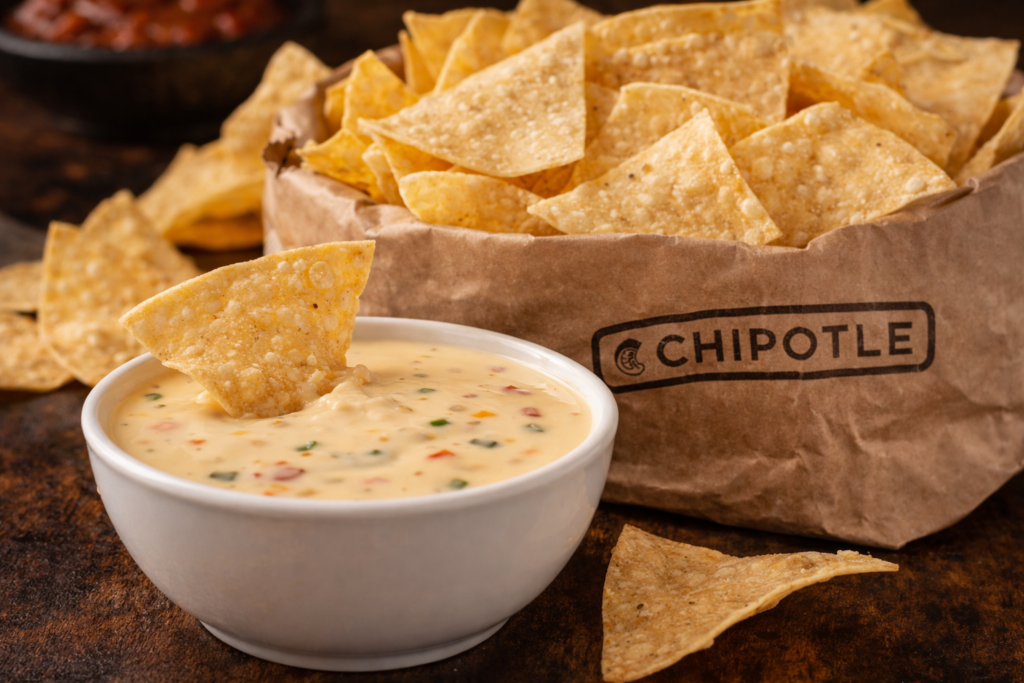
The sauce comes in a 2-ounce side portion and is served warm. It’s meant to be a dip for the chips, but plenty of customers use it as a topping for bowls, burritos, and even tacos. The texture is smooth but thick enough to coat a chip without being too runny.
For context, this is the same queso that’s available as a topping on their entrées. But the chips-and-queso format is the most popular way to order it. If you’re curious about how other menu items stack up nutritionally or flavor-wise, the Chipotle Carnitas Tacos review is a good companion piece, since carnitas and queso are a surprisingly good pairing.
First Taste: What the Experience Is Actually Like
The first thing you notice with Chips & Queso is the warmth. The queso is served hot, and the chips, at their best, are fresh from the fryer. There’s a specific moment when you dip a chip and pull it out—you get a string of cheese stretching from the cup. That visual is a big part of the appeal.
The flavor is mild. This surprises people. It’s not sharp cheddar, not aggressively spicy, not overwhelmingly smoky. Instead, it’s a mellow cheese sauce with subtle notes of tomato and a gentle heat that builds slightly after a few chips. The consistency is smooth, with no graininess, which is a common complaint with queso at other fast-casual chains.
The chips, which are the same lime-salted corn tortilla chips served with guacamole, provide the crunch and salt that balance the creamy, mild queso. A fresh chip—still warm, still crackling—is essential. A stale chip turns the experience from excellent to disappointing. This is why location and time of day matter more for chips and queso than for almost any other Chipotle item.
The Flavor Profile: What Works, What Doesn’t
Chipotle’s queso occupies an interesting middle ground. It’s not as sharp as a Wisconsin cheddar sauce, not as spicy as a jalapeño-laced queso, and not as thin as the nacho cheese you’d find at a movie theater. Instead, it lands somewhere in the middle, aiming for broad appeal.
The good: The sauce is consistent. The smooth texture works well with the crunch of the chips. The mild heat is accessible to almost anyone, including people who don’t like spicy food. The tomato and tomatillo base gives it a slight tang that cuts through the richness of the cheese.
The limitation: If you’re expecting a bold, complex queso with sharp cheddar or a strong roasted pepper flavor, this might feel underwhelming. It’s designed as a complement, not a centerpiece. For customers who want a more assertive cheese experience, the queso from competitors like Qdoba often has a stronger, more varied flavor profile. The full Chipotle vs Qdoba comparison explains exactly how their queso differs and which one might suit your taste better.
That said, the subtlety is intentional. Chipotle’s approach is to let the ingredients speak for themselves. The queso is not designed to overpower your bowl; it’s designed to add a layer of richness without dominating the other flavors.
Nutrition Breakdown: The Numbers You Should Know
Let’s get into the details. Chipotle’s Chips & Queso is not a low-calorie item. That’s fine—it’s not meant to be. But knowing the numbers helps you decide where it fits into your overall meal.
Chips & Queso (Standard Side)
- Calories: 660 (chips: 540, queso: 120)
- Fat: 34g (chips: 25g, queso: 9g)
- Carbohydrates: 77g (chips: 73g, queso: 4g)
- Protein: 12g (chips: 7g, queso: 5g)
- Sodium: ~1,200mg (combined)
Queso Alone (2 oz Side)
- Calories: 120
- Fat: 9g
- Carbohydrates: 4g
- Protein: 5g
- Sodium: ~400mg
The chips are the primary calorie driver here. A 4-ounce bag of chips contains 540 calories, which is more than many Chipotle entrees. The queso itself is relatively moderate at 120 calories per serving. If you’re watching your intake, the smarter move is to order the queso as a topping for your bowl and skip the chips, or share the chips with someone else.
The sodium content is worth noting. The combination of chips and queso contains over 1,200mg of sodium, which is about half the daily recommended limit for most adults. If you’re also having a bowl or burrito, total sodium can climb quickly. This isn’t a reason to avoid it, but it’s a reason to be aware of your overall intake.
Price & Value: Is It Worth the Cost?
In 2026, Chipotle’s Chips & Queso typically costs between $4.50 and $5.50, depending on location. A side of queso alone (without chips) is usually around $1.50 to $2.00.
The value question depends entirely on how you use it. As a standalone snack or side, the chips-and-queso combo at $5 is a moderate price for what you get. Compared to a full bowl or burrito, it’s not a value meal—it’s a treat. But compared to similar offerings at other fast-casual chains, it’s competitively priced.
Where queso really shines in value terms is as a topping. Adding queso to a bowl for $2 turns an otherwise standard meal into something richer and more indulgent. It’s cheaper than adding guacamole and, depending on your taste, equally satisfying. For customers who want to enhance their meal without spending $3+ on guac, queso is a strong alternative.
How to Customize Your Chips & Queso Experience
The standard chips-and-queso order is straightforward, but there are ways to adjust it to fit your preferences.
Ask for Extra Queso
If you’re sharing with a group or just want a better cheese-to-chip ratio, ask for a double portion of queso. There’s usually an upcharge, but it’s often less than ordering a second full side.
Get Chips Fresh
This is the most important customization. If the chips look like they’ve been sitting, ask if there’s a fresh batch coming out. Most locations will accommodate. Warm chips make a significant difference in the experience.
Add Queso to a Bowl or Tacos
This is where the real value lives. Adding queso to a bowl with carnitas or barbacoa creates a rich, layered meal. The mild cheese sauce complements the richness of carnitas particularly well, as noted in the carnitas taco review. It also works well with chicken, adding creaminess without the tang of sour cream.
Skip the Chips, Keep the Queso
For lower calorie or lower carb days, order the queso alone and use it as a topping or dip for the chips that come with your kids’ meal (if you’re ordering one) or as a sauce for your bowl. You get the flavor without the 540-calorie chip commitment.
When Chips & Queso Makes Sense
This isn’t an every-visit order for most people. But there are specific scenarios where it’s absolutely the right choice.
- Sharing with a group: The standard chips and queso is perfect for two people to split as a starter. The large size (more chips, double queso) works for three or four.
- As a lighter meal: If you’re not hungry enough for a full bowl, chips and queso alone can function as a meal. At 660 calories and 12g of protein, it’s filling enough for a lunch.
- When you want to upgrade a bowl: Adding queso to a bowl for $2 is one of the best value upgrades on the menu. It adds richness and protein without the high price tag of double meat or guacamole.
- When you’re ordering a milder protein: Carnitas and chicken both benefit from the added creaminess of queso. The mild cheese sauce complements their flavors without overpowering them.
When to Skip It
There are also situations where chips and queso doesn’t make sense.
- When you’re strictly counting calories: 660 calories for a side item is significant. If you’re trying to keep your meal under 800 total, skipping the chips and queso is usually the right call.
- When you’re on a low-carb diet: The chips alone add 73g of carbohydrates. The queso alone is low-carb, but the combo is not.
- When you’re ordering a heavy protein: Barbacoa or carnitas bowls are already rich. Adding queso on top can push the meal into “too heavy” territory.
- When you’re at a slow location late at night: If the chips have been sitting for hours, the experience degrades significantly. If the queso has been sitting too long, it can develop a skin on top. Both are signs to skip.
Chipotle vs Qdoba: The Queso Showdown
This is one of the most direct comparisons between the two chains. Qdoba built a significant part of its reputation around its queso. Chipotle’s queso came later and has always been the subject of debate. The full comparison guide covers this in depth, but here’s the short version for queso specifically.
Chipotle’s queso: Smoother, milder, with a slightly tangy tomato base. More consistent across locations. Less likely to separate or become grainy. Better for people who want a subtle cheese sauce that doesn’t compete with other flavors.
Qdoba’s queso: Bolder, cheesier, with a more pronounced pepper flavor. Qdoba offers multiple queso varieties (including a spicy option). It’s generally richer and more assertive. Better for people who want queso to be the dominant flavor.
There’s no objective winner here—it’s about preference. If you want queso as a subtle addition, Chipotle wins. If you want queso as a bold, cheesy centerpiece, Qdoba typically does it better.
Pros and Cons: The Honest Assessment
Pros:
- Smooth, consistent texture with no graininess
- Mild, accessible flavor that works with most proteins
- Great value as a $2 bowl topping
- Pairs exceptionally well with carnitas and chicken
- Fresh chips, when available, are excellent
Cons:
- Relatively mild—may not satisfy customers wanting bold cheese flavor
- Chips add 540 calories, making the combo a calorie-heavy item
- Quality depends heavily on chip freshness and queso turnover
- Not a strong value as a standalone snack compared to using it as a topping
Final Verdict: Is It Worth Ordering?
Chipotle’s Chips & Queso is a solid menu item with a specific place in the Chipotle ecosystem. It’s not the best choice for every visit, but when you want a rich, comforting addition to your meal, it delivers.
The final rating:
- Taste: 8/10 (Smooth and pleasant, but mild)
- Value (as a topping): 9/10 (Excellent)
- Value (as chips & queso combo): 7/10 (Moderate)
- Nutrition: 6/10 (High calories, moderate protein)
- Consistency: 7/10 (Depends on location and freshness)
- Overall: 7.5/10 (Good when used strategically)
The best way to order chips and queso is with a strategy: add queso to your bowl as a $2 upgrade, share chips with a friend, or enjoy it as a standalone treat when you’re not counting calories. When you approach it this way, it becomes one of the more satisfying additions Chipotle offers. When you treat it as an automatic add-on without considering the calories or cost, it can feel like an indulgence that doesn’t quite justify itself.
For customers who prioritize flavor and texture over strict calorie control, chips and queso is a worthwhile addition to any meal. And for anyone who hasn’t tried it as a bowl topping, that’s the move that might change how you order forever.
“`